


Singapore Office
8 Burn Road, #07-07, Trivex, Singapore 369977
Malaysia Office
No.11 Jalan Sri Wangi 1/5 , Taman Perindustrian Desa Plentong 81750 Masai, Johor, Malaysia
Bluewater Lab © All rights reserved Copyrights 2026
Loading ...
(Please refresh page if it's taking too long)
Singapore Office
8 Burn Road, #07-07, Trivex, Singapore 369977
Malaysia Office
No.11 Jalan Sri Wangi 1/5 , Taman Perindustrian Desa Plentong 81750 Masai, Johor, Malaysia
Bluewater Lab © All rights reserved Copyrights 2026

26 May 2025
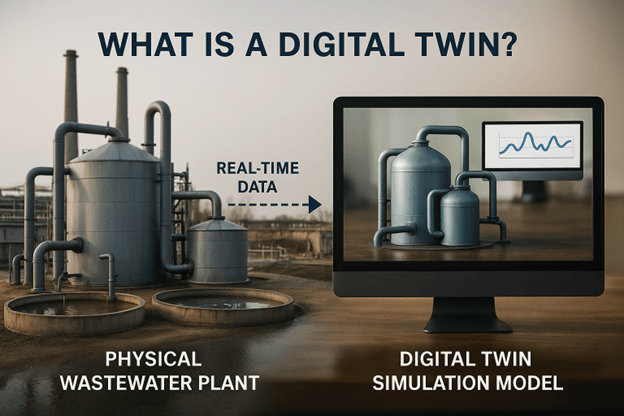
In practical terms, a digital twin in wastewater treatment is like a living, digital replica of your plant’s processes. It’s a dynamic simulation model of the wastewater treatment plant that continuously updates with data from the real facility. This means the model isn’t static – it pulls in live inputs (e.g. sensor readings, SCADA signals) and even laboratory results to mirror what’s happening on-site in near real-time. Essentially, the digital twin behaves just like your physical wastewater treatment process on your computer, allowing you to observe, analyze, and even predict plant performance under different conditions without touching the real system.
How does this work under the hood? The digital twin integrates operational data (flows, pollutant concentrations, pump statuses, etc.) with sophisticated process models. For example, it might use the same calculations as an activated sludge model, but constantly fed with current plant data. Some advanced twins maintain a two-way connection – often called a “digital thread” – where any changes or new data from the plant update the model, and insights from the model can be fed back to operators in real time. The result is a virtual environment that simulates wastewater operations almost as if one had a virtual WWTP running in parallel to the real one.
Crucially, a digital twin is not just a fancy dashboard – it’s a predictive tool. Because it’s driven by real data and accurate process simulation, you can ask “what if” questions in the twin. For instance, “What if the influent pollutant load suddenly doubles?” or “What if we tweak the aeration rate or change a chemical dose?” The twin will simulate how the plant would respond. This provides a safe sandbox for testing scenarios that would be risky or impossible to try in reality. In fact, digital twins are increasingly used to test operational changes and emergency responses virtually, so operators can refine strategies without disrupting actual operations.

For industrial wastewater plants, especially in manufacturing, adopting a digital twin can be a game-changer. Here are some of the key benefits and value-adds of deploying a digital twin for your wastewater treatment operations:
A digital twin lets you simulate sudden surges in pollutant load or changes in influent characteristics. For example, if an upstream process dump causes a spike in COD or ammonia, the twin can model the impact on your biological treatment and final effluent quality. Operators can virtually test mitigation steps (like adjusting aeration or adding chemicals) to handle the spike before it happens. This what-if simulation capability means fewer surprises – you can anticipate how the plant will cope with shocks. Utilities have noted that these virtual models enable safe and efficient testing of optimization strategies under varying loads without any risk to compliance. In other words, your team gets a foresight tool to handle upset conditions gracefully.

Wastewater treatment is often energy-intensive (think of all those aeration blowers and pumps) and uses costly chemicals. Digital twins help identify efficiency gains. By modeling the process, the twin can reveal opportunities to dial back aeration or optimize pump schedules while still meeting treatment targets. In practice, plants have saved significant energy by using digital twin-driven recommendations. For instance, Innichen-Sexten Wastewater Treatment Plant in Italy deployed a digital twin approach to optimize its aeration and was able to cut aeration energy consumption by 10%. The digital twin,a real-time, AI-powered simulation of its treatment process, to analyze both historical and live data like influent load, aeration levels, and chemical dosing. By running virtual test scenarios, the team identified and applied smarter control strategies for blowers and dosing systems. These AI-driven adjustments led to a 10% reduction in aeration energy, a 16% improvement in nitrogen removal, and a 25% improvement in phosphorus removal—all while maintaining effluent quality despite rising influent loads. These are real, quantifiable savings. Overall, by providing deep insights into the process, a twin supports optimized operations that reduce utility costs – from electricity to chemical reagents. Bluewater Lab’s SHIFT3 platform is very capable of replicating the same feat—but tailored for Southeast Asia. It can optimize aeration, reduce chemical use, and predict failures before they happen, all using real-time IoT data and machine learning.
If your goal is to improve efficiency in a WWTP while staying practical about local constraints, SHIFT3 is not just a match—it’s probably a better regional fit than more generic, Western-focused digital twin platforms.
Compliance with discharge standards is non-negotiable for wastewater operations. Digital twins give an early warning system for compliance issues. Because the model is predicting in real time, it can forecast if an effluent parameter (like BOD, COD, nitrogen, pH, etc.) is trending towards a permit limit breach. Operators can get alerts hours or days in advance of a potential violation and take corrective action proactively – for example, adjusting retention time or dosing coagulants ahead of a predicted high solids event. This predictive capability helps avoid compliance excursions before they happen. As an added benefit, it builds confidence with regulators since you’re leveraging technology to stay consistently within limits. In the Italian plant example, the goal of the digital twin was explicitly to support safe compliance with effluent limits while minimizing energy use – essentially hitting both regulatory and cost targets together. Many digital twin users report improved reliability of meeting discharge KPIs, because the twin reduces the trial-and-error in process adjustments. It’s like having a continuous advisor that says “if you keep this setting, you might exceed ammonia limits tomorrow – try doing X instead.”
A digital twin provides unparalleled visibility into your operations. It’s not just numbers on a SCADA screen; it’s a holistic view of how changes ripple through the treatment process. Managers and engineers can gain insights into which process step is the bottleneck or which parameter is most sensitive. According to industry leaders, “digital representations of physical assets, processes and systems – or digital twins – provide unparalleled insight into ongoing plant operations… supporting increased productivity, enhancing operational resilience and optimizing energy and chemical consumption”.
This means your team can make better decisions backed by data, not guesswork. With Bluewater Lab’s SHIFT3 platform, those insights don’t just sit on a dashboard. They’re compiled into clear, actionable reports that highlight what’s working, what’s at risk, and where efficiency gains can be made. Whether it’s planning maintenance, adjusting chemical dosing, or justifying upgrades to management, SHIFT3 gives your team the information they need to make confident, high-impact decisions.
Additionally, the twin can serve as a training simulator for new operators. Staff can practice responding to various scenarios (like equipment failures or sudden rain dilution in the wastewater) within the twin. This kind of hands-on training in a risk-free environment accelerates learning. Some plants even run operator training programs on their digital twin models, so that when a real incident occurs, the team has essentially “seen it before” in simulation.
In short, a digital twin turns your wastewater plant into a smart system that continuously learns and optimizes. By leveraging it, wastewater plant optimization becomes an ongoing, data-driven practice – leading to cost savings, more stable treatment performance, and greater peace of mind for operations managers.

If you’re running a medium-sized factory in Southeast Asia, you might be thinking, “This all sounds great in theory, but can we really implement a digital twin? We don’t have a huge budget or an army of sensors like the big municipal plants.” This is a very valid concern. Many cutting-edge digital twin projects (like the one in Singapore’s Changi mega-plant) involve extensive instrumentation and data infrastructure that smaller facilities lack. However, the good news is that digital twins are not only for giant utilities or high-tech companies. With the right approach, even mid-scale industrial WWTPs can start reaping the benefits of digital twin technology – without breaking the bank.
The key is to start small and smart. You do not necessarily need hundreds of sensors streaming data every second to build a useful digital twin. In fact, much value can be unlocked by using the data you likely already have. Most factories have at least some basic instrumentation and historical records: flow meter readings, pump run times, laboratory test results (e.g. weekly COD, pH, nutrient measurements), maybe a few online sensors for parameters like pH or dissolved oxygen. These are extremely valuable. Studies have shown that existing telemetry and lab data contain a wealth of information that can be leveraged to improve operations, without installing any new hardware. In other words, you can begin with a sort of “soft digital twin” that uses historical and periodically updated data, rather than a fully live, sensor-saturated system on day one.
Consider this approach: Build a simulation model of your treatment process using historical data to calibrate it. For example, use last year’s inflow and effluent data to tune a model of your anaerobic and aerobic treatment tanks. This model could initially run offline (say, you input yesterday’s values to predict today’s performance and see how close it gets). Even this historically-driven digital twin can start yielding insights – perhaps it shows that a certain spike in effluent ammonia in the past correlates with a specific production schedule or a certain aeration setting, suggesting a tweak in operations. Over time, as you gain confidence (and perhaps budget), you can add more sensors for real-time data and gradually transition the twin from a soft/offline mode to a live digital twin that updates continuously. Think of it as digital twin scalability: crawl (offline model) before you walk (partially automated twin) before you run (real-time integrated twin).
There are examples in Southeast Asia proving this scaled approach works. Many small-to-medium industrial parks and factories are beginning their digital journey by tapping into their existing data goldmine. A regional water tech study noted that facilities don’t need to add a lot of physical complexity or expensive new sensors to start seeing digital twin benefits. What’s important is ensuring the data you do have is accessible and usable. Even manual lab measurements, if fed into the model regularly (say daily or weekly), can keep the twin realistic. Modern digital twin platforms are quite flexible about data input frequency – continuous streaming is ideal, but not a must at the start.
Budget constraints are also addressed by focusing on the highest-return areas first. Instead of modeling every single aspect of the plant in extreme detail (which can be costly), you might start with the critical process units or key parameters that affect compliance and cost. For instance, maybe focus on the biological treatment where most variability occurs, and model that in detail while keeping peripheral parts simpler. This targeted strategy keeps implementation feasible for mid-sized operations. Several vendors and solution providers (including Bluewater Lab, which specializes in small-medium industrial wastewater systems in the region) offer starter packages that make step-by-step adoption possible.
In summary, a medium-scale factory in Southeast Asia can absolutely deploy a form of digital twin. Start with what you have – your historical data and a well-understood process model – and iterate from there. The result can be a “soft” digital twin using historical data that evolves into a full digital twin as your instrumentation and confidence grow. The journey can be phased and budget-friendly, and you’ll still get actionable insights early on. Don’t let the perfect be the enemy of the good; even a partially implemented digital twin can begin to optimize your wastewater operations today.
Getting a digital twin up and running involves a blend of data gathering, modeling, and continuous calibration. Here are some guidance and considerations for implementation:
First, identify what data is available and what additional data would significantly improve the model. At minimum, a wastewater digital twin will use operational data like flow rates, tank levels, pump statuses, valve positions, etc., and water quality data such as pH, COD/BOD, TSS, nutrient concentrations (ammonia, nitrate, phosphorus), dissolved oxygen, etc. This data can come from online sensors (instruments installed in the plant) and offline measurements (lab sample results). In modern plants, SCADA systems and IoT sensors provide a steady stream of real-time data, which a twin can leverage. But as discussed, even if you only have daily lab readings and periodic logs, these can be fed into the model as “dynamic inputs” albeit at a lower frequency. The goal is to integrate all relevant data sources – real-time and historical – to give the twin a comprehensive picture. In practice, effective digital twin platforms allow importing of SCADA data, manual lab results, and even environmental data (e.g., temperature, rainfall which might affect the process). Good data integration is crucial: garbage in, garbage out applies here, so ensure sensors are calibrated and data is reasonably clean. It’s often wise to start with a data audit or gap analysis: What data do we have? Is it trustworthy? What key measurements are missing for a good model? This will inform you if you need to add a sensor (for example, if you have no flow meter on a critical stream, that might be a worthwhile investment).
This is where Bluewater Lab adds value. SHIFT3 doesn’t just process data—it helps you identify the most important parameters to monitor based on your plant’s layout, processes, and risk areas. Their team can assess existing data streams and recommend where instrumentation upgrades would deliver the highest return, ensuring your model isn’t just smart—but well-informed.
Traditional process modeling (using first-principles mechanistic models like those in commercial WWTP simulators) is powerful, but complex biological and chemical processes sometimes don’t perfectly align with theoretical equations. This is where machine learning (ML) comes in as a valuable tool. ML algorithms can analyze historical data from your plant to identify patterns and relationships that might be hard to derive from theory alone. For instance, an ML model might learn the subtle relationship between raw wastewater composition, aeration blower frequency, and the resulting effluent quality, even if we don’t explicitly program those interactions. In cutting-edge implementations, the digital twin is a hybrid model – combining mechanistic process models with ML components. The mechanistic part ensures the model follows known scientific principles (mass balances, reaction kinetics), while the ML part can tweak and tune predictions based on real-world data trends, essentially filling in the gaps and improving accuracy. A great example is using artificial neural networks to emulate certain process outputs. In the earlier mentioned Italian plant, the digital twin incorporated neural network models to understand correlations between influent loads, operating conditions, and effluent results. This allowed the system to predict outcomes under various scenarios quickly and suggest optimal settings. For a medium-scale plant, you don’t need a PhD in AI to use ML – many platforms (and vendors like Bluewater Lab) embed these capabilities under the hood. The key is to provide quality data and domain knowledge, and the ML algorithms can then assist by continuously improving the twin’s predictive performance.
Building the digital twin model is not a one-time “set and forget” task. Calibration is the process of adjusting the model parameters so that the twin’s outputs match the real plant’s observed performance. Initially, you’ll calibrate the twin using historical data or dedicated test runs – for example, you might adjust biological reaction rates in the model until its predicted effluent matches past records closely. But after that initial setup, calibration remains an ongoing necessity. Think of the digital twin as an enduring “companion” to your plant; as the plant’s conditions evolve (fouling, seasonality, changes in production recipes in an industrial context), the twin should evolve too. The good news is today’s digital twin systems often include automated or assisted calibration features. One approach is the closed-loop digital twin, which uses algorithms (often ML-based) to automatically refine the model as new data comes in. In practice, the twin will compare its predictions with actual observed values from the plant each day and nudge its internal parameters to reduce any discrepancy. For example, if the twin predicted 8 mg/L nitrate but the lab result was 10 mg/L, it will adjust relevant parameters slightly. Over time, this keeps the twin highly accurate. Jacobs Engineering’s pilot at PUB Singapore exemplified this — the whole-plant digital twin continuously adjusted its calibrations within defined ranges via machine learning, ensuring the simulation stayed aligned with real operations without manual intervention. For your implementation, make sure to allocate time and resources for model validation and recalibration. Initially, you might recalibrate monthly or when discrepancies arise; with ML in the loop, much of this can be automated. Always verify the twin’s outputs against reality regularly, especially if you make any significant operational changes at the plant. A well-calibrated twin is a trusted advisor; a poorly calibrated twin can mislead, so this step is critical for long-term success.
Lastly, remember that a digital twin augments your team, it doesn’t replace their judgement. The human-in-the-loop aspect is important. Plant engineers and operators should be involved in setting up the twin (their insight ensures the model reflects real-world quirks), and they should use twin outputs as decision support, combined with their operational experience. When the twin flags an issue or suggests an optimization, it’s the experts on the ground who will evaluate feasibility and implement changes. Over time, as trust in the twin grows, it may take on a more autonomous role (for instance, feeding setpoints to an automated control system). But especially in the beginning, treat it as a collaborative tool for your operations team. Encourage your staff to interact with it, ask questions, and even challenge it – this leads to continuous improvement both of the model and the team’s digital skills.
Ready to unlock the benefits of a digital twin for your wastewater plant? Explore what Bluewater Master System can do for you. We invite you to reach out for a demonstration or consultation – let us show you how deeper insight into your wastewater operations can translate into real savings and peace of mind. (Contact Bluewater Lab today to discuss a digital twin strategy tailored to your factory’s needs.)

Bluewater Lab has recognized the immense potential of digital twins in transforming industrial wastewater management – and our Bluewater Master System is built with this digital twin philosophy in mind. In essence, Bluewater Master System is an integrated hardware-software platform that brings advanced data analytics and automation to factory wastewater operations. It provides deep process monitoring, predictive insights, and easy integration, which together lay the groundwork for implementing a full digital twin of your plant. Just as importantly, the information delivered by Bluewater Lab’s SHIFT3 platform is visually intuitive, making complex data easy to understand at a glance. This is especially valuable for stakeholders who aren't technicians or operators, such as plant managers or executives, who need clear insights to make informed decisions without getting lost in technical jargon. SHIFT3 bridges the gap between advanced analytics and practical, everyday usability.
The Bluewater Master System acts as a central nervous system for your wastewater treatment process. It continuously monitors a wide range of process parameters – from flow rates and pump currents to pH, ORP, and nutrient levels – in one unified dashboard. Our design philosophy is “digitalization with a purpose”, meaning we gather data not for the sake of it, but to drive better decisions. The platform can interface with your existing sensors and even pull in manual readings, consolidating all relevant data. By diving deep into your production and wastewater facility data, the Master System helps you see patterns and anomalies that would be hard to catch otherwise. It also enables you to define relationships between key parameters (like flow rate and chemical dosing efficiency) that support smarter, data-driven decisions across your operations.This comprehensive visibility is the first step toward a digital twin; you can’t model what you don’t measure. With Bluewater Master System in place, your plant’s data is no longer siloed in disparate instruments or logbooks – it’s live and ready for analysis.
Beyond just monitoring, Bluewater Master System has built-in intelligence to predict outcomes and flag issues early. Using machine learning and domain-specific algorithms, the platform analyzes incoming data 24/7 to forecast trends. For example, if the system detects a combination of factors that historically led to an effluent violation or a process upset, it will alert you before the issue fully develops. Our SHIFT 3 module is a great example of this capability – it runs continuously and leverages ML to anticipate any “collapse” in treatment performance, essentially preventing environmental wastewater crises before they occur. This is very much in line with digital twin functionality: the system is not just showing current numbers, but projecting ahead to guide proactive action. Bluewater Master System can thus serve as a starting version of a digital twin, where our algorithms simulate near-future scenarios (e.g., predicting tomorrow’s effluent quality based on today’s data and trends) and provide actionable recommendations. Many of our clients have told us it’s like having an expert co-pilot for the plant at all times.
We understand that factories in Southeast Asia often have a mix of old and new equipment. The Bluewater Master System is designed as a “universal platform for your legacy factory”. That means it’s hardware-agnostic and highly integrative – we can connect to PLCs, SCADA, data historians, and even retrofit sensors onto older systems as needed. This integration readiness is crucial for digital twin deployments. It ensures that when you want to incorporate more data streams or add a sophisticated process model, the underlying infrastructure is already in place to support it. Bluewater Master System is essentially a digital twin–ready: it can serve as the data pipeline and user interface for a future digital twin model of your WWTP. In fact, the platform already monitors, predicts, and optimizes wastewater facilities in a single environment – core functions you’d expect from a digital twin. When you’re ready to take the next step (for instance, plugging in a full-blown simulation model of your plant), Bluewater Master System will seamlessly accommodate it, because it’s built on modern, open standards and robust APIs for data exchange.
Implementing new technology can be daunting, but that’s where our expertise comes in. Bluewater Lab’s team has deep experience in both wastewater process engineering and AI-driven analytics. We have deployed our solutions to more than 40 factories across Indonesia and Southeast Asia, spanning various industries and wastewater challenges. This means we’ve likely seen a setup similar to yours and know how to tailor a solution that fits. Our approach is very much collaborative – we’ll work with your operations staff to identify key pain points and goals, configure the Bluewater Master System to address them, and gradually introduce digital twin elements at a pace that suits your organization. Whether it’s setting up a basic monitoring dashboard or developing a custom simulation model for your treatment process, we’re with you at every step.

Digital twin technology in wastewater treatment is no longer just a buzzword reserved for high-end utilities; it’s an accessible, practical tool that can deliver wastewater plant optimization for factories and utilities of all sizes. By creating a virtual counterpart of your treatment plant, you gain a powerful decision-support ally – one that helps you simulate wastewater operations, predict problems before they happen, and uncover efficiency improvements that directly boost your bottom line. For factory operations managers and environmental engineers in Southeast Asia, this means you can move from reactive firefighting to proactive, data-driven management of your WWTP.
Implementing a digital twin does come with challenges – it requires an investment in data and modeling, and a change in mindset to trust and use the digital insights. But as we’ve outlined, you can start modestly and build up over time. Even incremental steps can yield early wins, which often free up resources (through cost savings) to fund further digital upgrades. The experiences of others, from a dairy processing factory in Sumatra to large utilities in Singapore, all point to the same conclusion: the future of wastewater operations is digital, predictive, and optimized. Adopting a digital twin is a key part of this future, enabling smarter compliance, greener operations, and more cost-effective performance.
At Bluewater Lab, we are excited to help drive this transformation. Our mission is to bring the power of technology into conventional operations in a practical way. The Bluewater Master System embodies this mission, offering a ready pathway for facilities in our region to join the digital revolution in wastewater management. If you’re curious about how a digital twin might look for your plant, or if you want to identify opportunities for wastewater treatment optimization using your own data, we’re here to help.
Ready to transform your wastewater treatment with a full-scale digital twin? Contact Bluewater Lab today to explore our wastewater digital twin solution—built to simulate your plant operations, predict compliance risks, and drive energy and chemical savings. With our proven digital twin for wastewater operations, you’ll gain continuous insights, meet discharge standards confidently, and unlock real-world cost reductions. Don’t wait—kick off your wastewater digital twin journey now and see how a digital twin can optimize every aspect of your treatment process.